

Benefits of Blogging for Business (And Why Strategy Makes All the Difference)
You might be surprised to hear that blogging still works in the age of AI, but it definitely can if it’s strategic. Here are the real benefits of blogging for business and how to make them actually show up for your service-based website.

TL;DR Summary
Benefits of Blogging for Business
- Blogging builds compounding visibility that social media posts simply cannot—your content lives on your site, not on a rented platform
- Strategic blog posts attract the right search traffic and warm up potential clients before they ever reach out
- Blogging delivers a strong return on investment by reducing long-term customer acquisition costs compared to paid advertising
- Connecting each post to a keyword, an offer, and a next step is what makes blogging a business tool instead of a side project
- The Strategic Content Toolkit: Blogging gives you the framework to blog with purpose, and the Strategic Content & Website System handles it for you when you’re ready to delegate
Why Blogging Works… When It’s Actually Strategic
Ask most service providers about their blog and you’ll hear some version of the same story. They started strong, published a few posts, didn’t see much happen, and eventually stopped. The posts are still there, just quietly gathering dust.
The thing is, blogging does work. It’s one of the most reliable ways to grow visibility, build trust with the right people, and bring consistent traffic to your website without paying for ads or showing up on social media every day. The problem isn’t the idea but the approach.
Posting without a strategy is like sending emails without a subject line. You did the work, but you removed the part that makes it effective.
This post is about what blogging actually does for a service-based business when it’s done intentionally, and what gets in the way when it isn’t.

Benefit 1: Visibility That Keeps Working After You Hit Publish
Social media posts have a lifespan measured in hours. A well-written blog post can bring people to your website for months or years after you publish it.
That’s not an exaggeration. It’s just how search works. When someone types a question into Google that your post answers, your site has a chance to show up. That doesn’t happen with an Instagram caption or a LinkedIn post, both of which disappear from feeds quickly and live on platforms you don’t own.
Your blog is the only content you fully own. It lives on your website, it builds on itself over time, and it compounds in a way that rented platforms simply don’t.
This is why consistency matters more than volume. Publishing one thoughtful, well-structured post per month outperforms a burst of five posts followed by six months of silence.
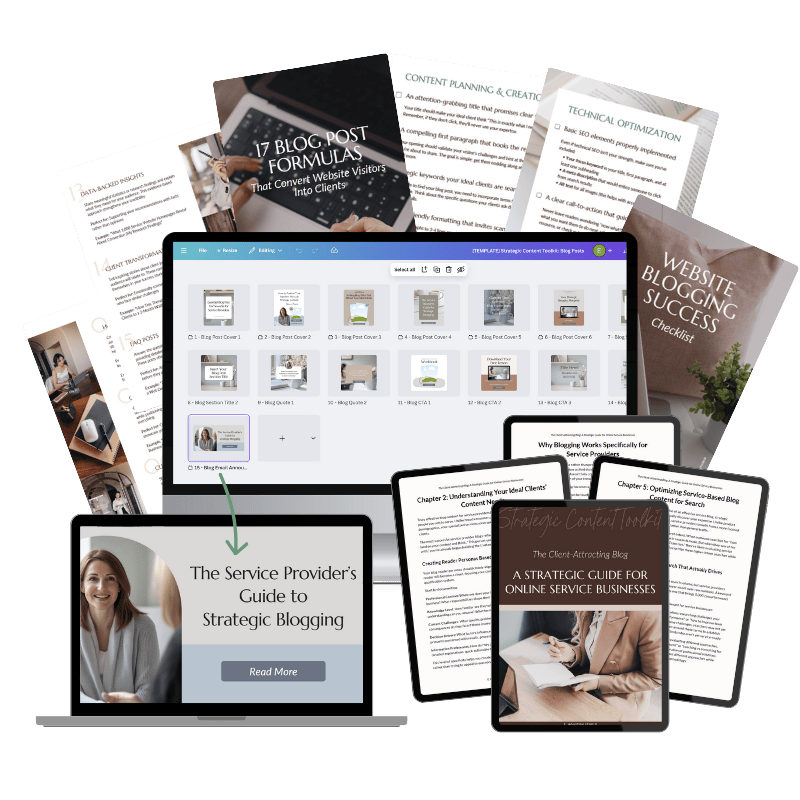
Want a framework for blogging that actually works?
The Strategic Content Toolkit: Blogging is a comprehensive resource that covers how to choose topics connected to your offers, structure posts for SEO and readability, and build a content system that compounds over time.
Benefit 2: SEO Without Stuffing Keywords Onto Your Homepage
One of the most practical benefits of blogging for business is what it does for search visibility: specifically, the kind of visibility that reaches people who don’t already know you exist.
Your homepage and service pages are doing a specific job: converting visitors who are already considering working with you. They’re not the right place to target every keyword variation your ideal client might search for. That’s what your blog is for.
Each post is a new opportunity to get found for a specific question, phrase, or topic. A post about website navigation tips reaches someone who’s frustrated with their site. A post about what to include on a homepage reaches someone who’s building one. A post about the benefits of blogging for business reaches someone who’s weighing whether it’s worth their time.
None of those people were searching for a web designer. But they found one. That’s the quiet power of a strategic blog.
The key word in all of this is strategic. Choosing topics based on what your ideal clients are actually searching for (rather than what feels interesting to write about) is what separates a blog that drives traffic from one that doesn’t.

Benefit 3: Trust That Builds Before Anyone Contacts You
By the time a potential client fills out your contact form, they’ve usually read more than one page on your site. For many service providers, at least one of those pages is a blog post.
That matters because it changes the dynamic of the conversation. Someone who found you through a blog post, read two or three more, and spent fifteen minutes with your thinking before reaching out is a very different inquiry than someone who landed on your homepage from an ad and filled out a form on impulse.
Blog content does a specific kind of trust-building that a service page can’t. It shows how you think. It demonstrates that you actually know what you’re talking about. It lets someone evaluate your approach before committing to a conversation, which means when they do reach out, they’re further along in the decision than a cold lead would be. That’s what positions you as a thought leader in your space, and what builds real brand awareness over time.
It also filters. When your posts reflect your actual values and approach clearly, the people who resonate with them are likely to be good-fit clients. The people who don’t will self-select out before they ever contact you.
“One of the best business decisions I’ve made is adding Liz and her services! She takes my written content and provides creative, clean, on-brand design to convey my message. I completely trust to her give me feedback, elevate my words and visuals all while completing tasks in a timely, efficient manner. She’s also fun and supportive to boot!”


Benefit 4: One Post Does More Than One Job
A blog post isn’t just a blog post. Once it’s written and published, it becomes a resource you can reference in client conversations, a piece you can share in your email newsletter, a basis for a social post, and something a referral partner can send to someone who’s asking questions you answer well.
This is especially relevant for service providers who feel like they’re constantly generating new content for different channels. A strategic blog post can feed multiple platforms without requiring you to start from scratch each time. The post is the source material. Everything else is a shorter version of it.
When each post is built around a specific topic and connected to a clear next step, that repurposing happens naturally. Rather than just stretching thin content across channels, you’re giving substantial content a wider reach.

Why Most Business Blogs Don’t Get Results
If blogging has all these benefits, why do so many service providers try it and give up? Usually one of four reasons:
- No keyword connection. Posts are written based on what feels useful to write, not on keyword research into what people are actually searching for. The content is good, but it’s invisible because no one is looking for it that way.
- No offer connection. Each post is standalone with no clear next step. Someone reads it, gets value, and leaves. There’s no path from the content to an inquiry.
- No consistency. A burst of posts followed by a long gap tells search engines and potential clients the same thing: this site isn’t being actively maintained. Consistent, even if infrequent, beats sporadic every time.
- No structure. Posts without headings, clear sections, and a logical flow are harder to read and harder to rank. Your writing needs to be organized in a way that both humans and search engines can follow.
None of these are hard to fix. But they do require thinking about each post as part of a larger system and not just a standalone piece of content. Small businesses in particular tend to see the most meaningful return once they shift from random posting to a connected content strategy.
What Strategic Blogging Actually Looks Like
A strategic blog post starts with a question or problem your ideal client is already searching for. It answers that question clearly and thoroughly, using the language your reader would use. It’s structured with headings, a logical flow, and genuine depth, not padded length.
It connects to something: an offer, a freebie, a related post. The reader finishes with a clear sense of what to do next if they want more.
And it’s published consistently enough that your site gradually becomes a reference point for the topics you care most about. That’s when the compounding starts to show up in traffic, in inquiries, and in the quality of conversations you’re having with potential clients.
That’s the version of blogging that actually works for a service business. Not more posts—better-connected ones.

Discover Which Content Path Fits Your Business Best
Ready for a content system that keeps your site visible without doing it all yourself?
The Strategic Content & Website System is the ongoing framework for service providers who want consistent, strategic content published to their site every month. Topics are chosen to align with your offers and audience. Posts are written, formatted, and published for you. Your site stays active and visible while you focus on your clients.
Frequently Asked Questions
What are the main benefits of blogging for a service-based business?
Blogging builds compounding search visibility, attracts potential clients who are already looking for what you offer, establishes credibility before anyone contacts you, and gives you content that can be repurposed across your website, email list, and social channels. The benefits are real, but they depend on consistent, strategic execution rather than occasional posting.
How long does it take to see results from blogging?
Most service providers start to see meaningful search traffic within 3 to 6 months of consistent, strategically focused blogging. Individual posts can rank sooner, but the compounding effect of a growing content library takes time to build. The businesses that give up at month two or three are usually the ones who were closest to seeing traction.
How often should I publish blog posts for my business?
Consistency matters more than frequency. Publishing one well-researched, properly structured post per month and maintaining that schedule will outperform publishing four posts in a week followed by months of silence. If you’re just starting, one post per month is a sustainable target. Two per month, when you’re ready, is where compounding starts to accelerate.
What should I blog about for my service business?
Start with the questions your ideal clients are already asking, the problems they’re trying to solve before they find you, and the decisions they’re weighing. Each of those is a potential post topic with a built-in search audience. The most effective business blogs stay tightly focused on the intersection of what their ideal client needs to know and what the business actually helps with rather than trying to cover everything.
What specific business metrics improve with blogging?
For service providers, the most meaningful indicators tend to be organic traffic (how many people are finding you through search), time on site (a signal that content is resonating and visitors are reading more than one page), and lead quality (inquiries from people who have already read your thinking and are further along in their decision). Raw visitor numbers matter less than whether the right people are finding you and taking meaningful action when they do.


